Oral history & cultural preservation
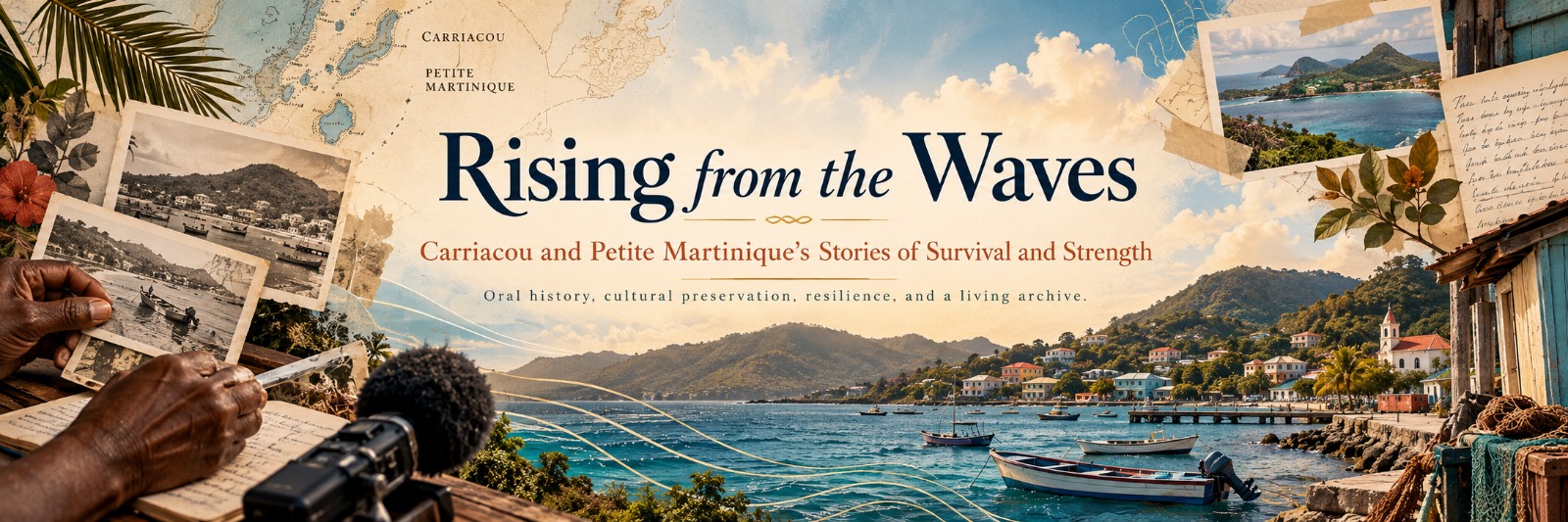
Carriacou and Petite Martinique’s stories of survival and strength.
2026–ongoing
Principal Investigator
Christiana Best-Giacomini, Ph.D.
Rising from the Waves documents the lived experiences and collective memories of the people of Carriacou and Petite Martinique before, during, and after Hurricane Beryl in July 2024.
Rooted in the Caribbean tradition of oral storytelling, the project recognizes everyday people as keepers of history. Recorded interviews preserve first-person accounts of family, culture, loss, displacement, survival, rebuilding, and resilience knowledge that can be carried across generations.
The research centers the voices of residents while exploring how cultural knowledge, social networks, collective memory, and local resources help individuals, families, and communities recover after disaster.
Before, during & after
A history larger than one storm.
Memories of life before Beryl are central to the project: family histories, community relationships, traditions, livelihoods, cultural practices, migration experiences, connections to land and sea, and the stories of earlier generations.
Preserving these histories alongside accounts of the storm and rebuilding helps document how identity, belonging, and connection continue through disruption. The work connects local experience with broader conversations about climate change, migration, disaster recovery, and cultural preservation.
Listening & collective memory
Community voices at the center.
The project uses a trauma-informed, community-centered approach to oral history. Alongside individual interviews, healing circles and collective storytelling are envisioned as opportunities to reflect on shared experiences of grief, survival, connection, and recovery.
Training local youth and graduate students in oral history methods is among the project’s goals. This work seeks to preserve firsthand accounts often absent from official records while affirming the knowledge held within the community.
A living archive in development
Hear the stories. Encounter the places. Preserve the memory.
The planned digital archive aims to preserve at least 30 recorded oral histories, alongside a curated exhibition for communities in Grenada and the diaspora, educators, students, researchers, and the wider public.
As fieldwork progresses, materials will be collected, reviewed, and appropriately cleared for public use. The archive is envisioned to grow throughout the 2026–2027 fieldwork period.
Longer-term outcomes include a book-length manuscript of edited narratives, scholarly publications and presentations, educational materials, and public programming. The digital exhibition is also intended to support the restoration of the hurricane-damaged Carriacou Museum.
The developing digital experience may include
- Recorded oral histories and participants’ voices.
- Contemporary portraits, historical images, and family photographs.
- Maps connecting villages, landmarks, and cultural spaces with memories.
- Video, environmental footage, archival documents, and artifacts.
- Selected field notes, researcher reflections, and stories connected to place.
Community & collaboration
Preserving memory together.
The project brings oral history, cultural preservation, education, and community knowledge into conversation, with connections across Grenada, the islands, and the wider diaspora.
The work also connects with government, nongovernmental organizations, tourism and hospitality, and local businesses.
Be part of the conversation.
Christiana welcomes conversations with cultural and educational collaborators, funding partners, videographers, and people with archiving and technology expertise who share an interest in preserving community memory.
View all research